How to play 13-card rummy, in the order the rules actually matter.
Most beginners try to learn rummy by reading the full ruleset. We think that is the wrong order — the ruleset has dependencies that only make sense after you have watched one hand play out. This page walks through one hand, in the order the events happen, and points you to the rulebook for anything we have had to compress.
What you need
One standard deck of 52 cards plus jokers (the 13-card Indian format typically uses one printed joker and one wildcard), two to six players, and a flat surface. Most operator platforms enforce a two-player minimum and a six-player maximum; four-player tables are the most common online because they preserve session pace.
The printed joker is always wild. The wildcard is the card that matches the rank of the printed joker's rank suit (for example, if the printed joker is a black joker, the wildcard is any 7 of clubs or any 7 of spades — operator-specific, check the lobby). On most platforms, the joker and the wildcard are functionally equivalent and you will see them referred to interchangeably.

The deal
Each player receives thirteen cards face-down. The dealer turns the next card face-up beside the deck — that is the open discard pile. The remaining deck is the closed draw pile. Play proceeds clockwise.
On most operator platforms the deal is automated. If you are playing at home, the dealer's job is to deal one card at a time in rotation, then place the next card face-up to start the discard pile. The player to the dealer's left goes first; they take the face-up discard or draw from the closed pile, then make their first discard.
Your first draw is the most important decision of the hand, but only if the face-up discard is useful. If it does not advance a meld, draw from the closed pile — the face-up card is usually claimed by the player who can use it immediately.
Build a meld
A meld is a group of three or more cards that form either a sequence (consecutive ranks of the same suit, like 4-5-6 of hearts) or a set (same rank across three or four suits, like three kings). The 13-card Indian format requires at least one pure sequence before you can declare — a "pure" sequence is one built without using a joker.
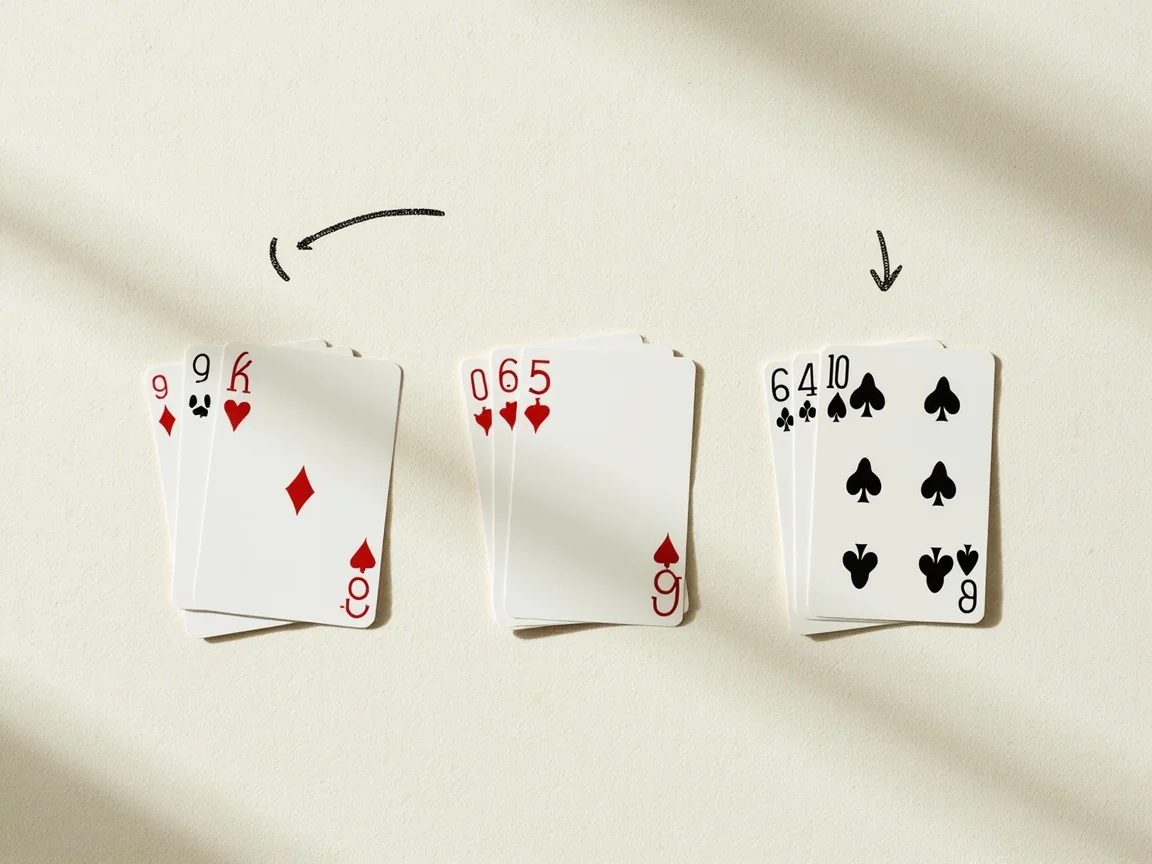
Two kinds of impure melds exist. An impure sequence substitutes a joker for a missing card (so 4-5-joker-7 of hearts is a valid impure sequence because the joker stands in for the 6). A set with a joker is also valid, but most operators cap jokers at one per meld.
The pure-sequence requirement
The pure-sequence requirement is the single rule that catches new players most often. A valid hand with no pure sequence is still not a valid declaration, even if it has two sets and an impure sequence. The reason is structural: without a pure sequence, a player could build their entire hand from jokers, which collapses the skill gradient the game is built around.
Discard
End your turn by discarding one card face-up. The card you discard becomes available to the player on your left as their draw option on their next turn. Most operators allow you to discard the card you just drew — this is normal and not a sign of a missed opportunity.

Your discard is the only signal your opponent gets about your hand. Discarding a high card of a suit your opponent is collecting telegraphs a void in that suit — which is information you may not want to give. Read the strategy page for how to think about safe discards versus loaded discards.
Declare
When your hand is a valid declaration — at least one pure sequence and at least one additional grouping (sequence or set), with the remaining ungrouped cards totalling zero or below the table's allowed deadwood threshold — lay your hand face-up on the table before discarding your final card. The discard that ends the hand is the one that pushes your ungrouped card count to zero (or below the threshold) and is itself not discarded; it is placed with the rest of the declaration.
A wrong declaration — laying down a hand that does not meet the rules — costs you the full-count penalty plus the opponent's score. This is the single biggest swing in points rummy. Always lay your hand down on the table and read it back to yourself before you commit.
The joker rule

The joker can substitute for any missing card in a sequence or set, with two restrictions. First, a joker cannot be the first card of a pure sequence (the joker is, by definition, not a real card of any suit). Second, most operators cap jokers at one per meld. Some operator variants allow two jokers per meld in exchange for a tighter declaration requirement — we do not recommend starting with the relaxed variant.
Scoring arithmetic
Number cards count at face value. Face cards (J, Q, K) and the ace count at 10 points each. A joker's value is the value of the card it substitutes for. The total of an opponent's ungrouped cards at the moment of your declaration is what you score against them.
Drop penalties apply when you decide not to continue a hand. First drop costs 25 points (most operators), middle drop costs 50, and missing the declaration entirely costs 80 plus the opponent's ungrouped score (this is the "full count"). These penalties exist because dropping at the wrong moment is a strategic move, not a safety valve — the penalty prices it.
Common first mistakes
The five mistakes that account for the most lost money in the first hundred hands, in order of frequency:
- Building a set before a pure sequence. A set is easier to build but cannot stand alone. Sequence first, then set, then second sequence.
- Hoarding jokers. A joker in hand is worth less than a joker already placed in a meld. Place jokers early and let your opponents see the structure you have committed to.
- Discarding into a known suit. If the player on your left has been drawing from the closed pile consistently for two turns, they are collecting one suit. Do not discard a card of that suit unless you can read the deadwood count from their play.
- Declaring on a hand with two sets and no pure sequence. The hand looks finished but is invalid. Always check for the pure sequence first.
- Forgetting the drop penalty. Dropping out of a hand because you are losing costs you points. Sometimes the right move is to drop, sometimes it is to ride the hand out — but the decision should be made with the penalty in mind, not after.
What to read next
When you have completed three or four hands without making any of the five mistakes above, move on to the strategy page. The strategy page assumes you can play the rules without thinking, and focuses on the decisions the rules leave open.
For a format-level comparison, the games hub walks through points, pool, deals and gin variants side by side.
A short reading list for the next month
The beginner walkthrough covers the rules you need to play your first ten hands without making a serious mistake. The next month of reading is about turning those rules into a working table read. Four resources, in order of priority.
One: your own session log. The single most useful study tool is a paper score pad you keep beside the table. Log the date, the table ID, the stake, the number of hands, the result and a one-line note about the decision you most regret. After thirty sessions, the regrets will cluster — that is your curriculum.
Two: the operator's help pages, read once. Open the operator's help centre. Search for "declaration". Read the page on wrong declaration, missed declaration and drop penalties. Search for "joker". Read the page that explains whether one joker per meld is the cap or whether two are allowed. Search for "withdrawal". Read the processing time and the threshold verification rule.
Three: the rules of the format you actually play. The 13-card Indian Rummy standard is published by the Rummy Federation of India and is the authoritative source for the format's rules. Most operator help pages are summaries of that standard with platform-specific modifications; reading the original clarifies which rules are platform-specific and which are the format's own.
Four: the strategy page, after you have thirty sessions logged. The strategy page is written for readers who can play the rules without thinking. Read it after thirty sessions, not before, because the strategy insights are only meaningful when you have enough of your own play to compare them against.
Five edge cases worth knowing now
Most beginners encounter the same five edge cases within their first hundred hands. None of them is exotic; all of them are answered in the operator's help pages; almost none of them is obvious from the rules alone.
Edge case 1 — the auto-drop at second life
Some operators offer a "second life" feature that gives the player one free drop per session — a drop that costs zero penalty instead of the standard 25 points. The feature is opt-in and the rule varies by operator: some allow it once per session, some once per day. If you play on an operator with this feature, decide in advance whether you will use it and reserve it for the moment a hand is structurally unplayable, not for the moment you are simply losing.
Edge case 2 — the show vs the declare
On most operators, "show" and "declare" are the same action — laying your hand face-up before discarding your final card. On a small number of operators, "show" is a request to the engine to validate the hand, and "declare" is the commit. The two-step pattern exists to protect players from committing to invalid hands, but it costs a turn. Read the operator's help page to confirm which pattern your platform uses.
Edge case 3 — the merged sequence
A merged sequence is a sequence that uses the joker plus one or two real cards to extend across a rank boundary. Most operators permit merged sequences as long as the joker stands in for one card only and the result is still a valid sequence in the suit. A merged sequence that uses the joker to bridge two missing cards is invalid under most rule sets.
Edge case 4 — the discarded wild
If the joker or wildcard is discarded early in the hand, it is no longer available for melding. This sounds obvious but it has a strategy implication: the discard of a joker is one of the most informative signals a player can give, because it announces that they are not collecting joker substitutes for any of their current melds. Read your opponent's joker discard as a structural commitment.
Edge case 5 — the timed turn
Online operators enforce a turn timer (typically 30 seconds). When the timer expires, the engine auto-discards the top card of your hand for you. The auto-discard is rarely the card you would have chosen. Plan your turns so that you are not making a discard decision at the buzzer; the structural integrity of your hand depends on it.
When to stop the session
Three signs that the right move is to leave the table, in order of how often they appear.
The first sign is session time. If you set a 90-minute time budget and you are at 88 minutes, stop. The next hand is a hand you will play tired, and tired hands cost more than they win.
The second sign is stake. If you set a session stake limit and you are at it, stop. The next hand is a hand you are playing with money you have already committed to losing, and that is the hand you are most likely to chase with.
The third sign is tilt. Tilt is the state of playing worse than your normal level because the last hand hurt. The signs are visible: clicking faster, taking longer on the same decisions, switching tables without thinking. If you recognise tilt in yourself, leave the table and take the rest of the day off. The responsible-play page has operator-side tools that enforce the stop when self-discipline does not.
Reading the rules at the table
Every Indian Rummy operator publishes its own rulebook, and almost none of them are identical. The 13-card format is the format-level standard, but the small print — the part that decides whether a hand is valid or a penalty applies — is platform-specific. The same game played on two different operators can have different joker caps, different drop penalties, different declaration validation steps, and different turn timers. Reading the rulebook is not optional; it is the difference between a hand that counts and a hand that costs you points.
The fastest way to read a rulebook is to ignore the introduction and search for the four sections that change behaviour: joker rules, declaration validation, drop penalties, and turn timer. Each section is usually one paragraph. Read those four paragraphs in that order before your first hand on a new platform. The introduction tells you the format; the four short sections tell you how the platform charges you when you get the format wrong.
During play, the rulebook should be open in a second tab. The situations that force a re-read are predictable: a hand that ends in a contested show, a joker rule that you have not encountered on this operator before, and a drop penalty you are about to incur. Treat these as the three triggers that justify pausing play to check the rule. Re-reading the rulebook mid-hand for a question you could have answered with the rules you already know is the behaviour of a player who has not yet learned to separate the platform-specific from the format-level.
Operators update their rulebook more often than players notice. A joker rule you learned six months ago may have been changed in a platform-side terms-of-service revision that you accepted on login. Re-read the four short sections of the rulebook once per quarter; the rest of the document is stable enough that you only need to read it once.
Five things beginners get wrong about declarations
Invalid declarations are the most expensive mistake a beginner can make in points rummy. The cost is the full-count penalty plus the opponent's ungrouped score, which can be a hundred points or more in a single hand. The five mistakes below account for the majority of those invalid declarations, in order of frequency.
- No pure sequence in the declared hand. A declaration that has two sets and an impure sequence still fails validation, because the pure-sequence requirement is non-negotiable under the format-level standard. The fix is mechanical: before laying your hand down, identify the longest run of consecutive same-suit cards you have and confirm that it contains no joker. If it does not exist, you are not ready to declare — draw or drop, but do not commit.
- A joker placed at the head of a sequence. A pure sequence is one that contains no joker at any position, including the head. A 4-5-6 of hearts with the joker standing in for the 7 is an impure sequence; the same hand with the joker standing in for the 4 is invalid by definition, because a joker is not a card of any suit. The fix is to lay out the sequence in your head before you place the joker, and to confirm that the resulting run is real even if every joker were removed.
- Two jokers in the same meld. Some operators cap jokers at one per meld; some allow two in exchange for a tighter declaration requirement. The default assumption — one joker per meld — is correct on most platforms but wrong on a minority. The fix is to read the joker section of the rulebook once, on your first session, and to remember which cap your platform uses. The cost of getting it wrong is a failed declaration, which is the full-count penalty.
- An ungrouped card left at the end of the hand. A declaration requires all thirteen cards to be placed in valid melds, with zero ungrouped cards remaining. Beginners sometimes lay down twelve cards in three clean melds and forget the thirteenth. The fix is to count cards before you commit: thirteen cards in, thirteen cards in melds, zero remaining. If the count is off, you have either miscounted your hand or are about to declare invalidly.
- Declaring before the engine has validated the hand. On operators that distinguish between show and declare, the show is a request for the engine to validate the hand, and the declare is the commit. Beginners sometimes press declare directly, skipping the show, because they trust the hand without checking. The fix is to always show first: the engine's validation step exists to protect you from the cost of an invalid declare, and skipping it removes the only safety net the platform gives you before the penalty is applied.
The full-count penalty on an invalid declaration is the single biggest swing in points rummy. Read the rulebook's declaration-validation section before your first hand on a new platform, and re-read the joker section once per quarter. The other rules are stable enough that one careful reading is sufficient.